El cuerpo perdido: Una mirada a la ergofobia desde la perspectiva somática [Reseña de investigación]. The Lost Body. A Look at Ergophobia from a Somatic Perspective [Research Review]
—
[EXTRACT]. A COLLECTIVE LEAP TO MENTAL HEALTH THROUGH SOCIAL-SPECIFIC NARRATIVES. A THEORETICAL AND PRACTICAL APPROACH.
At this point, I hope you will permit us to move on to a more pragmatic phase whose main lines I feel you will all share with us. On many occasions we have maintained a mutual interest not only in the practice of psychology and therapeutic care but also in the importance of culture as a fundamental instrument of transition.
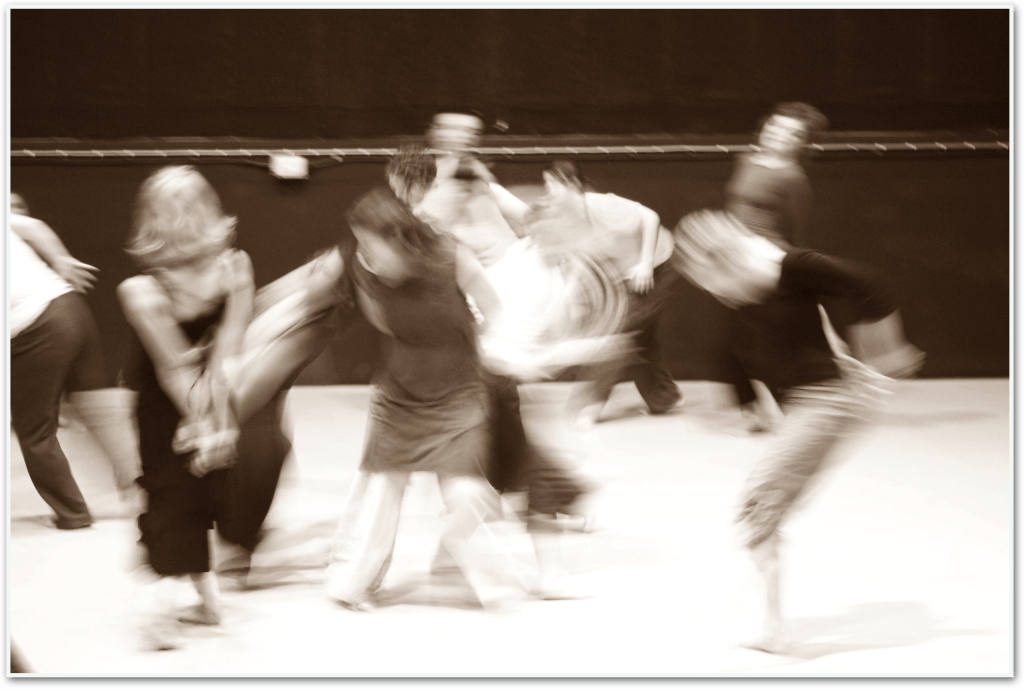
As you know in our “parallel lives” among studies and practices in psychology, our professional fields come across culture and the performing arts as a primary expressive station, considering everything related to the body as a hole a vehicle for transformation. Those principals represent our main engine in everything we undertake, whether structural or practical. Connecting with the metaphor of circular time that we have previously expressed, we find that the elemental paradox of “finding the real in an unreal situation” – we use the metaphor of scene/stage as an element of extrapolation to a broader scope – generates a “suspended” or “protected” moment with a single autonomy that activates a transitional springboard, becoming a qualitative experiential leap.
We fundamentally emphasize the possibility of using the tools that this “suspended” time may offer to a certain group of people, whether they have been labeled by the medical-scientific paradigm as “sick” or not. Among them, we point out the principle of “extraordinary listening” or “extreme listening” in this “suspended”, safe and playful time, which intensely reinforces the bond between narrator and listener, strengthening empathy and facilitating an illusion of exchange in which that which cannot be named takes up its own space in an indirect way. The possibility of narrating ourselves among equals, collectively, is part of the restorative nature of any therapeutic process, thus restructuring what we experience by empathizing with “the other’s life stories”. We strengthen the bases of our own new mental schemes.
Let’s take into account:
- That we people do not build representation models based exclusively on logical patterns but rather on images or propositions of convenience, accessibility and effectiveness based on specific information (narratives).
- The fundamental corollaries of fragmentation, communality and sociability collected by George A. Kelly in his Personal Construct Theory.
Therefore, sharing core processes through the tools of social-specific narrative frees us by incorporating strategies through which we heal individual experiences which are now collectively and indirectly addressed. Why use narration or memories/stories as raw material in our proposal? Memories are generally accompanied by replicable visual images that give us a feeling of time travel. At the same time, they invite us to learn from past experiences, establishing and maintaining social relationships, the regulation of emotions, and the creation of a sense of belonging (Mutafoğlu, 2021).
In Kelly’s words, what makes a group psychologically similar among its members is not that they have the same tools to construct the events, but rather their ability to build a common experience together (Kelly (1996/1970), cited in Feixas and Villegas, 2000). In this sense, it seems plausible to point out that we create and recreate our life stories based on the elements that are most attractive to the attention of others, just as happens with our personal identities, forged more strongly through the way in which we are perceived by others according to Cooley’s “Looking-Glass Self” Theory.
Besides the psychodynamic concepts of transference and countertransference, here we wonder about the figure of the professional who listens through the prism of a social-specific narrative. Giving an horizontal and indirect voice to people and experiences that cannot be expressed except as stigmas in the linear therapeutic time acquires a broader perspective in this “suspended” and circular time, admitting the possibility of a truthfully healing contact, with the potential to counteract this stigmatization and diagnostic stereotyping, currently constraining.
Another function that we hope we can work on through practice is the promotion of an individual sensitivity on collective identity, more strongly configured if we manage to reach the goal of representation where affections and empathy take root among participants. We are no longer talking about “patients” as much as about “participants”. In the social-specific narrative we narrate our own realities (the social) anchored, indirectly, to something present in the here and now over this “suspended” time (specific) and therefore we are all fostering an attitude of bond based on respect for the autonomy and authenticity of the group. We, as facilitators, take on the roles of validating guides who follow that constructivist approach we have previously shared.
A crucial aspect to highlight is the playful dimension of our approach. In this already “suspended” space-time of “extraordinary listening” the game becomes an essential tool at our disposal. The game is the key that unlocks and serves participants in a holding environment (Winnicott, 1971). This holding environment is necessary to develop and encourage bonds and empathy. In fact, without play as a fundamental tool, we would return to the blockage of all rational-individualistic experiences. We cannot use the games from the limited perspective of a childhood practice, although it truly begins to develop as such during this stage of vital development, – as Winnicott points out -, and it does also take important variations in the adult stage, asserting itself as humor and creativity (Winnicott, 1971), or as a threshold of authenticity for the true self.
We will try to expose through practice the lines that games predispose for the development of the social-specific narratives, in particular for the channeling of life stories embodied by the group of participants. To achieve this, we will develop the Obstacle exercises, -as well as others-, with a set of premises anchored to the already tested tradition of mindfulness, as the path has demonstrated clinical effectiveness in treatments that range from addiction intervention, eating disorders or, in our case of study, affective disorders.
 dactilar(e)s